![Bosch Smart radiator thermostat II [+M]](/images/products/radiator-valves/bosch-smart-radiator-thermostat-2-smart-radiator-valve.webp)
Option 1 · Bosch
Bosch Smart radiator thermostat II [+M]
Last updated October 2026
View full device profile
The Smart Device Compare comparison
Understand the differences. Decide what matters to your home.
Build another comparison →Before you compare every specification
A summary of selected recorded differences between these radiator valves. Check the full specification table below for details and conditions.
These observations are derived from recorded catalog data and have not all been independently verified. Confirm details with the manufacturer before purchasing.
Compare capabilities, compatibility and setup requirements.
Option 1 · Bosch
Last updated October 2026
View full device profile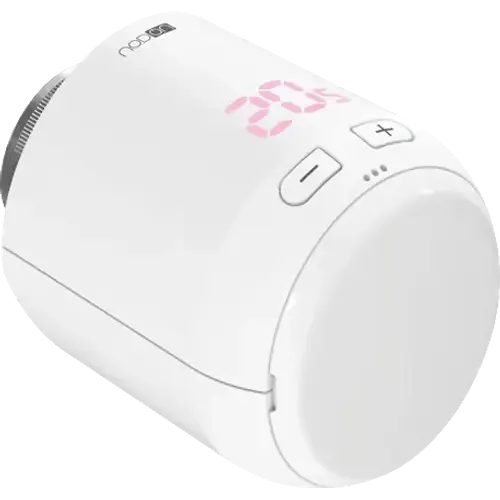
Option 2 · NodOn
Last updated October 2026
View full device profileWhat the catalog tells us
These counts describe the available data, not a quality score. More features do not automatically make a better device.
Consider your setup
Confirm which features appear in Apple Home and whether extra hardware or a subscription is needed for your intended use.
Inspect the specificationsConsider your setup
Confirm the exact device type and the features exposed in your chosen platform. Protocol support does not establish feature parity across apps.
Inspect the specificationsYour priorities, side by side
Mark the specifications you care about. Open manufacturer sources for verification scope; fields without citations remain catalog data. Expand notes for other qualifications.
Showing 27 of 27 rows. “Not recorded” does not mean “No”.
The 2.4 GHz radio is Zigbee (IEEE 802.15.4), not Wi-Fi.
Zigbee 3.0 end device at 2.4 GHz with a maximum radio power of +8 dBm, so it joins an existing Zigbee network and needs a compatible coordinator or gateway. | NodOn lists Home Assistant, Jeedom, Zigbee2MQTT, WiziNote, Energeasy Connect, Otodo, Alexa and Edalso as compatible gateways for this model. | Battery-powered, so it is an end device only and not a Zigbee router.
An LED matrix shows the temperature value plus the radio, pairing, calibration, key-lock, Boost, Off, low-battery and error indicators.
NodOn documents automated scenarios based on lifestyle habits and automatic shut-off when a window is open, driven from the compatible gateway or home automation system. | The valve cycles itself once a week to limit lime and scale.
Children’s hands on radiator thermostats often lead to incorrect settings and wasted energy. But there is no need to sweat (or freeze) as a result: | Specify in the app or using the operating button on the device that manual settings on the device itself are no longer possible. | This way, kids cannot adjust anything on the smart thermostats, and you can still control the room temperature conveniently via app, voice assistant or room thermostat.
A key lock disables the buttons on the device so the temperature cannot be changed by hand, and Zigbee2MQTT exposes it as child_lock.
The display shows the temperature value and the heating state on the device, and the measured room temperature is exposed to the gateway as local_temperature.
No external temperature sensor.
Prevents damage to radiators owing to open windows or unused rooms.
Frost protection mode is supported.
No geofencing. Any location automation has to be built in the gateway.
NodOn lists Alexa among the compatible gateways for this model, and its Zigbee range is documented as working with Amazon Alexa gateways.
Not compatible with Apple Home.
Not compatible with Google Home.
Zigbee2MQTT publishes a device page for this exact model, the TRV-4-1-00, exposing child lock, climate, battery, valve position and the display controls. | A technical review tested the valve on Home Assistant and reports it pairs cleanly through ZHA as well, as a climate entity with battery, heating-demand and setpoint-limit entities. | NodOn also lists Home Assistant among the compatible gateways for this model.
The radio is Zigbee 3.0 only, with no Matter certification or Matter path documented for this model.
Not compatible with Samsung SmartThings.
The NodOn user guide states a battery lifespan of 2 years, and the valve must be recalibrated whenever the cells are replaced.
The valve uses two 1.5 V AA/LR6 batteries.
NodOn Zigbee Thermostatic Radiator Valve manufacturer product page →Document check only; not a hands-on test or verification of every regional or firmware variant.
Two 1.5 V AA/LR6 cells power the valve, supplied in the box; NodOn advises against rechargeable batteries.
There is no learning or adaptive scheduling on the valve: any automatic behaviour is built in the gateway from the exposed sensor and setpoint entities.
NodOn documents programming of heating time slots and creation of automated scenarios through a compatible Zigbee gateway, and the setpoint can also be changed on the device between 8 and 28 degrees Celsius.
The datasheet states an operating humidity of 0-90% rH, not a humidity sensor.
The valve measures room temperature itself and exposes it to the gateway as local_temperature, with a local temperature calibration offset. | The user guide notes a temperature offset setting and a calibration run after installation and after every battery change.
| Specification | Bosch Smart radiator thermostat II [+M] | NodOn Zigbee Thermostatic Radiator Valve |
|---|---|---|
| Connectivity | ||
| No | NoCatalog noteThe 2.4 GHz radio is Zigbee (IEEE 802.15.4), not Wi-Fi. | |
| No | No | |
| No | No | |
| Thread Border Router required | No | |
| No | No | |
| Zigbee Hub required | Zigbee Hub requiredCatalog noteZigbee 3.0 end device at 2.4 GHz with a maximum radio power of +8 dBm, so it joins an existing Zigbee network and needs a compatible coordinator or gateway. | NodOn lists Home Assistant, Jeedom, Zigbee2MQTT, WiziNote, Energeasy Connect, Otodo, Alexa and Edalso as compatible gateways for this model. | Battery-powered, so it is an end device only and not a Zigbee router. | |
| Display | ||
| Yes | YesCatalog noteAn LED matrix shows the temperature value plus the radio, pairing, calibration, key-lock, Boost, Off, low-battery and error indicators. | |
| Not recorded | LED matrix | |
| Features | ||
| Yes | YesCatalog noteNodOn documents automated scenarios based on lifestyle habits and automatic shut-off when a window is open, driven from the compatible gateway or home automation system. | The valve cycles itself once a week to limit lime and scale. | |
YesCatalog noteChildren’s hands on radiator thermostats often lead to incorrect settings and wasted energy. But there is no need to sweat (or freeze) as a result: | Specify in the app or using the operating button on the device that manual settings on the device itself are no longer possible. | This way, kids cannot adjust anything on the smart thermostats, and you can still control the room temperature conveniently via app, voice assistant or room thermostat. | YesCatalog noteA key lock disables the buttons on the device so the temperature cannot be changed by hand, and Zigbee2MQTT exposes it as child_lock. | |
| Yes | YesCatalog noteThe display shows the temperature value and the heating state on the device, and the measured room temperature is exposed to the gateway as local_temperature. | |
| No | NoCatalog noteNo external temperature sensor. | |
YesCatalog notePrevents damage to radiators owing to open windows or unused rooms. | YesCatalog noteFrost protection mode is supported. | |
| No | NoCatalog noteNo geofencing. Any location automation has to be built in the gateway. | |
| Integrations | ||
| Yes | YesCatalog noteNodOn lists Alexa among the compatible gateways for this model, and its Zigbee range is documented as working with Amazon Alexa gateways. | |
| Yes | NoCatalog noteNot compatible with Apple Home. | |
| Yes | NoCatalog noteNot compatible with Google Home. | |
| Yes | YesCatalog noteZigbee2MQTT publishes a device page for this exact model, the TRV-4-1-00, exposing child lock, climate, battery, valve position and the display controls. | A technical review tested the valve on Home Assistant and reports it pairs cleanly through ZHA as well, as a climate entity with battery, heating-demand and setpoint-limit entities. | NodOn also lists Home Assistant among the compatible gateways for this model. | |
| Yes | NoCatalog noteThe radio is Zigbee 3.0 only, with no Matter certification or Matter path documented for this model. | |
| Yes | NoCatalog noteNot compatible with Samsung SmartThings. | |
| Power | ||
| 2 years | 2 yearsCatalog noteThe NodOn user guide states a battery lifespan of 2 years, and the valve must be recalibrated whenever the cells are replaced. | |
| 2x AA | 2x AAManufacturer sourceThe valve uses two 1.5 V AA/LR6 batteries. NodOn Zigbee Thermostatic Radiator Valve manufacturer product page →
Document check only; not a hands-on test or verification of every regional or firmware variant. Catalog noteTwo 1.5 V AA/LR6 cells power the valve, supplied in the box; NodOn advises against rechargeable batteries. | |
| Scheduling | ||
| No | NoCatalog noteThere is no learning or adaptive scheduling on the valve: any automatic behaviour is built in the gateway from the exposed sensor and setpoint entities. | |
| Yes | YesCatalog noteNodOn documents programming of heating time slots and creation of automated scenarios through a compatible Zigbee gateway, and the setpoint can also be changed on the device between 8 and 28 degrees Celsius. | |
| No | No | |
| Sensors | ||
| No | NoCatalog noteThe datasheet states an operating humidity of 0-90% rH, not a humidity sensor. | |
| Yes | YesCatalog noteThe valve measures room temperature itself and exposes it to the gateway as local_temperature, with a local temperature calibration offset. | The user guide notes a temperature offset setting and a calibration run after installation and after every battery change. | |
The table matches specifications by section and field. It preserves notes, separates missing data from explicit “No” values, and keeps qualifications attached to their values. No overall winner is assigned from feature counts.
Read our comparison methodology